Pages

Showing posts with label Arizona. Show all posts

Tuesday, May 31, 2016

Junior Ranger Review: Tuzigoot National Monument

We visited Tuzigoot in April 2016.


Tuzigoot is a village built by the Sinagua people on top of a hill and close to the Verde river. Sinagua is Spanish (sin agua) meaning "without water" and refers to the way these people managed to survive in this high desert landscape. Tuzigoot was occupied by the same people and at the same time as Montezuma Castle, which is another national monument we've visited. The neat thing archaeologists found here were lots of BIG pots, and you can see them in the visitor center/museum. Tuzigoot has the walls standing so you can see where all the rooms were. The rooms weren't very big, but each one was actually a house for an entire family.They must have spent a lot of time outside.


The junior ranger program here is available for kids as young as 1 year old, which is great if you have little ones. The little kids mainly have to look for things. Do you see a pot? Do you see a wall? Do you see a sign? The answers for the big kids are on the trail signs around the ruin and also in the visitor center/museum exhibits. Nice badge!


Right next to Tuzigoot there is a turnoff on the road with a sign that says Verde River Access. Be sure to take this turn off and take some time to explore the river. There's a gravel parking lot with a porta-potty and a path to the river. It's cool and shady under the cottonwoods ( a nice change from being out in the sun at Tuzigoot) and the water has a shallow area perfect for kids to poke about in. 
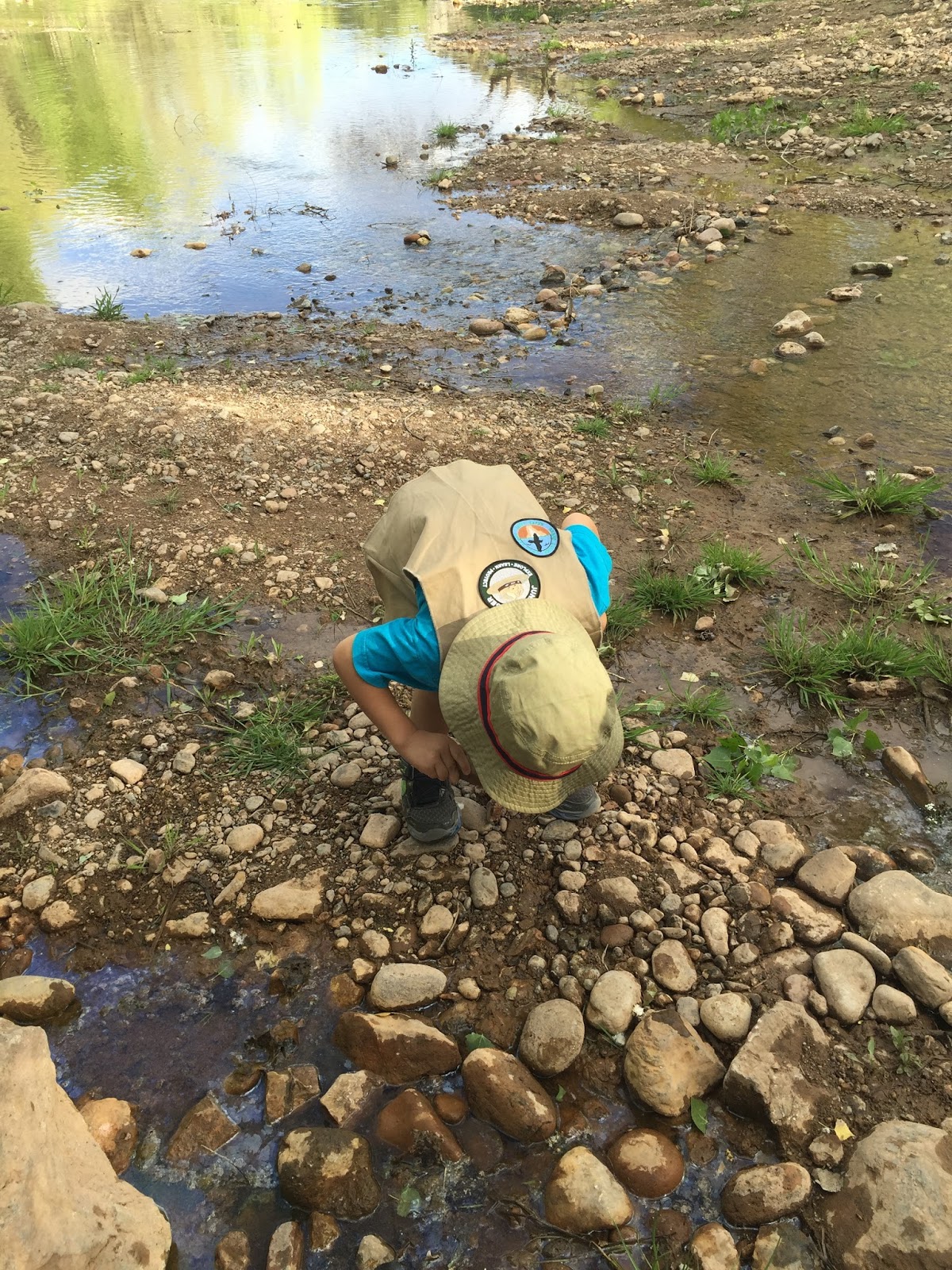

You can also hike along the river. It's easy to see why the Sinagua people liked it around here!

Cool and shady under the cottonwood trees.


Junior Ranger Review: Casa Grande Ruins

We visited the Casa Grande Ruins in March 2016.

Casa Grande National Monument in Arizona is conveniently located between Phoenix and Tucson.  It's a great place to check out for a couple of hours. Ancient Sonoran desert people (sometimes called Hohokam) built it 650 years ago. It had 4 floors and the logs used to build the ceilings were hand carried over 50 miles from the nearest forest, because the people had no pack animals or carts. About 600 logs were needed to build it, so that is an amazing amount of work! The current protective roof was built in 1932, which is surprising since it looks so modern. And it has always had owls living in it. Before there were park rangers to protect these amazing ruins, many people too chunks of the ruin and carved their names into it and you can still see the damage today, which is very sad.

Be sure to have the kids look for the secret room on the site. In the museum/visitor center there's also a great touch table that is very interesting for kids. It had rattlesnake skin, cactus boots (which are actually bird nests from inside a saguaro cactus), antlers, cactus skeleton, and other interesting items. The best part about Casa Grande Ruins is that the badges we earned are made out of wood! Beautiful!


Junior Ranger: "It's big! It's huge! It's large! I've never seen anything like the Casa Grande before!"

Mom: "I never realized how complex of a society the people had back then in this area. They had a society with farmers, artists, and rulers--to be able to build this large 4-story structure with materials brought from so far away.  And they figured out what to do with all that caliche they dug up in their fields. That's what they used to make the adobe. It's just like cement and has lasted for 600 years. Geniuses."

Junior Ranger Review: Montezuma Castle

We visited Montezuma Castle in March 2016.

Montezuma Castle in central Arizona is an amazing place. It's easy to see why the Sinagua people wanted to call this little corner home. The cliff curves around two sides, and on the third side is Beaver creek. It is shaded by cottonwood trees and beautiful Arizona sycamore trees with their silvery bark. The cliff had natural holes in it which the people only had to enlarge or build upon.  Sinagua is Spanish (sin agua) meaning "without water" and refers to the way these people managed to survive in this high desert landscape.

Our camera went dead just before our visit, so we didn't take any pictures at the Castle. Here's a video so you can see what it looks like:


The fourth side of this little area is the visitor center/museum, picnic area, and parking lot. You enter through the visitor center.

The junior ranger program here is set up for kids as young as age 1! We have a 2 year old, so we love it when he can easily be included. The little ones are asked to look for things (castle, bird, hole in rock, etc) and a coloring page (so make sure you bring colored pencils or crayons). There is a separate booklet for older kids. They have to find information primarily in the museum area of the visitor center, and also on trail signs outdoors.

And here's the badge:


Junior Ranger: "I liked having our lunch in the picnic area and after it was fun standing on the little berm by the creek and trying to throw sticks into the creek."

Mom: "There was a guy here today playing on a native American wooden flute and it was echoing on the cliffs. It gave us a feeling of the people who lived here. It's amazing to think about the little children that lived here climbing up and down that cliff each day!"

Saturday, April 16, 2016

Junior Ranger Review: Petrified Forest National Park


We visited the Petrified Forest in March 2016.


The Petrified Forest National Park in northern Arizona is in a pretty barren landscape, but there are huge logs of petrified wood, many of which are still lying where they fell, looking like they are still made of wood, even though now they are solid rock. Some of the petrified wood has cracked into chunks where you can see they contain may different beautiful colors of stone and sometimes even an iridescent shimmer. This park is right next to the famous Painted Desert, but we didn't have time to check that out on this trip.

We did the junior ranger program entirely at the the Rainbow Forest Museum and the trail that runs behind it. This museum is the first visitor center you encounter when you enter the park. The museum is small but has some cool exhibits with dinosaur skeletons! The exhibits give you a great idea of the huge ancient forest that was here, deep rivers, and the amazing plants and animals that populated it. There were ferns, conifers, giant crocodile-like reptiles and giant salamander-like amphibians. It's all hard to imagine now, since the area is so dry, empty, and rocky.

The junior ranger booklet is for the most part a scavenger hunt type deal. Kids have to find things in the museum and outside on the trail. The booklet has some coloring parts, so we were glad we brought our colored pencils. It asks you to color the petrified logs with all the colors you see in them. When we finished the ranger gave us the usual petrified forest badges and also junior ranger patches, which was neat.

Junior Ranger: "I thought we were going to a forest. But it was really a desert. That was a surprise!"

Mom: "During their pledge, the ranger made the kids swear to eat their vegetables--ha!"

Friday, April 15, 2016

Junior Ranger Review: Grand Canyon


We visited the Grand Canyon in March of 2016.


The Grand Canyon is an amazing place and people come from all over the world to see it. We've been here several times and the park is always very busy and it's hard to even find a parking place near the visitor's center! In the same area they have both a visitor center where the rangers are, and a bookstore where all the souvenirs are.

Head to the visitor center once you manage to park and get your junior ranger booklets. The junior ranger badge here has 3 levels for children of different ages. Pages with ravens on them are for kids 4-7; pages with coyotes are for kids 8-10, and pages with scorpions are for 11 and up. The program also requires attending a ranger talk, and the ranger has to sign their books. The ranger talks are offered throughout the day. The one we attended was about elk. We learned about keeping our distance from elk and the differences between deer and elk and between antlers and horns. The ranger brought out some elk antlers that we could touch.


After completing all the book pages, kids get sworn in and get their badges. If you are visiting late in the day you can get sworn in at the bookstore which stays open later than the visitor's center. Also at the bookstore, you can purchase the coordinating junior ranger patches for $2 each. The patches are quite nice and each age-range's patch is unique, so we bought them. We got the raven and coyote patches.We learned there is also a special junior ranger patch you can get if you make it down to the bottom of the canyon. Maybe next time!


Junior Ranger: "I love the Grand Canyon; it's so big. The best part this time was there was some snow on the ground and I got to play in it!"

Mom: "There were so many people around the visitor center that one of my kids to got lost in the crowd for a minute. That was scary. And there were elk strolling through the parking lot!"


Thursday, April 7, 2016

Arizona Junior Ranger Programs

 Arizona NPS Junior Ranger Programs & State Park Junior Ranger programs

Arizona has some great national parks and monuments, including the Grand Canyon and the the Petrified Forest. Here's the full list of Arizona national parks, monuments, and memorials that have junior ranger badges. Click to go right to the junior ranger page. Further down they have been organized by region to help you plan a trip. Arizona also has a state park junior ranger program where you can earn buttons. Information for that program is at the bottom of the page.

National Parks Alphabetical List:
  1. Casa Grande Ruins National Monument (wooden badge!)
  2. Canyon de Chelly National Monument
  3. Chiricahua National Monument
  4. Coronado National Memorial
  5. Fort Bowie National Historic Site
  6. Glen Canyon National Recreation Area
  7. Grand Canyon National Park
  8. Grand Canyon-Parashant National Monument (No facilities or visitor contact areas within the monument boundaries, so this is a mail-in badge or get it at the Interagency Information Center in St. George, Utah)
  9. Hubbell Trading Post National Historic Site
  10. Juan Bautista de Anza National Historic Trail (web ranger badge)
  11. Lake Mead National Recreation Area
  12. Montezuma Castle National Monument/Montezuma Well
  13. Organ Pipe Cactus National Monument
  14. Petrified Forest National Park
  15. Pipe Spring National Monument
  16. Navajo National Monument
  17. Sunset Crater Volcano National Monument
  18. Tonto National Monument
  19. Tumacacori National Historical Park
  20. Tuzigoot National Monument
  21. Walnut Canyon National Monument
  22. Wupatki National Monument
National Parks Organized by Region:
Northern Arizona
Central Arizona
Southern Arizona
Arizona State Park Junior Ranger Programs (Earn buttons)
Western Arizona


Northern Arizona


Eastern Arizona 


Southern Arizona